Heritage Walking Trail: Blyth
A 3.5-mile walking trail through 900 years of Blyth's history -- from the medieval port and coal staithes to the wartime battery, Ridley Park, and the offshore wind turbines that define the town's future.
This self-guided heritage walk covers roughly 3.5 miles and takes around two hours at a comfortable pace, with time to stop and read the interpretation boards along the way. It links many of the key sites in Blyth's story -- from a medieval salt port to Europe's largest coal exporter, through two world wars, and into a future built on clean energy.
The route is almost entirely flat and follows paved paths, promenades, and pavements. It is suitable for pushchairs and wheelchairs, though the section across the Links to the Battery involves a grass and compacted gravel path that may be less accessible in wet weather.
Best for: Allow around two hours for the full trail. The route is 3.5 miles and mostly flat on paved surfaces.
Stop 1: Commissioners Quay (Start)
Distance to next stop: 0.3 miles | 5 minutes
Begin at Commissioners Quay, the heart of the modern harbour. The quay takes its name from the Blyth Harbour Commissioners, who managed the port from the nineteenth century through its coal-exporting heyday. Today, the quayside is home to the Commissioners Quay Inn and a cluster of small businesses, but in the early twentieth century this stretch of waterfront was one of the busiest commercial ports in England.
Stand at the quayside edge and look across the river. The harbour you see today is a fraction of its former scale. At its peak, the river was lined with coal staithes, the massive timber structures that loaded coal directly into the holds of waiting ships. Millions of tons left this harbour every year.
Read more about the harbour's story in our History of Blyth Port guide.
Stop 2: Spirit of the Staithes
Distance to next stop: 0.4 miles | 7 minutes
Walk east along the quayside towards Wellington Street East. Here you will find the Spirit of the Staithes, a 16-metre steel sculpture created by artist Simon Packard in 2002. From one precise viewpoint on Wellington Street East, seven flat blocks of polished stainless steel lock together to form a life-size steam locomotive suspended at the height where the old coal staithes once stood.
The sculpture commemorates the coal trade that defined Blyth for over two centuries. The Blyth and Tyne Railway connected six collieries to the port, and the staithes along this stretch of river were among the busiest in Northumberland.
Stop 3: The Old High Street and St Cuthbert's Church
Distance to next stop: 0.5 miles | 8 minutes
Head south from the quayside into Blyth's old town centre along Waterloo Road and Bridge Street. This was the commercial heart of the town during the coal era, when shops, banks, and pubs served the thousands of workers who kept the port running.
Turn onto Church Street to find St Cuthbert's Church, one of Blyth's oldest surviving buildings. A church has stood on this site since the medieval period, serving the small fishing and salt-panning community that preceded the coal boom. The current building dates largely from the nineteenth century, but the churchyard contains gravestones that trace Blyth's story back through centuries of mariners, miners, and merchants.
Stop 4: Ridley Park
Distance to next stop: 0.6 miles | 10 minutes
Continue south along Bridge Street and turn onto Park Road to reach Ridley Park, the green heart of Blyth. The park was gifted to the town by Viscount Ridley and opened in 1904, at the height of Blyth's prosperity as a coal port.
The park features formal gardens, a bandstand, mature trees, play areas for children, and a free water play area in summer. It is a fine example of an Edwardian municipal park, built during an era when civic pride and industrial wealth combined to create public spaces that served entire communities.
Take time to walk through the rose garden and past the war memorial, which commemorates Blyth's losses in both world wars.
Stop 5: Crofton Gate and the Pit Villages
Distance to next stop: 0.5 miles | 8 minutes
From Ridley Park, head east towards Crofton and the edge of the old pit village communities. The residential streets you walk through here -- Cowpen, Crofton, Newsham -- were built to house the families who worked in the collieries that surrounded Blyth. At its peak, six collieries operated in and around the town: Cowpen, Bates, Blyth (Isabella), Cambois, New Delaval, and Bedlington.
The coal heritage of Blyth is woven into these streets. Each pit village had its own social club, chapel, and identity, and many remain distinct communities today.
Stop 6: South Beach and the Beach Huts
Distance to next stop: 0.4 miles | 7 minutes
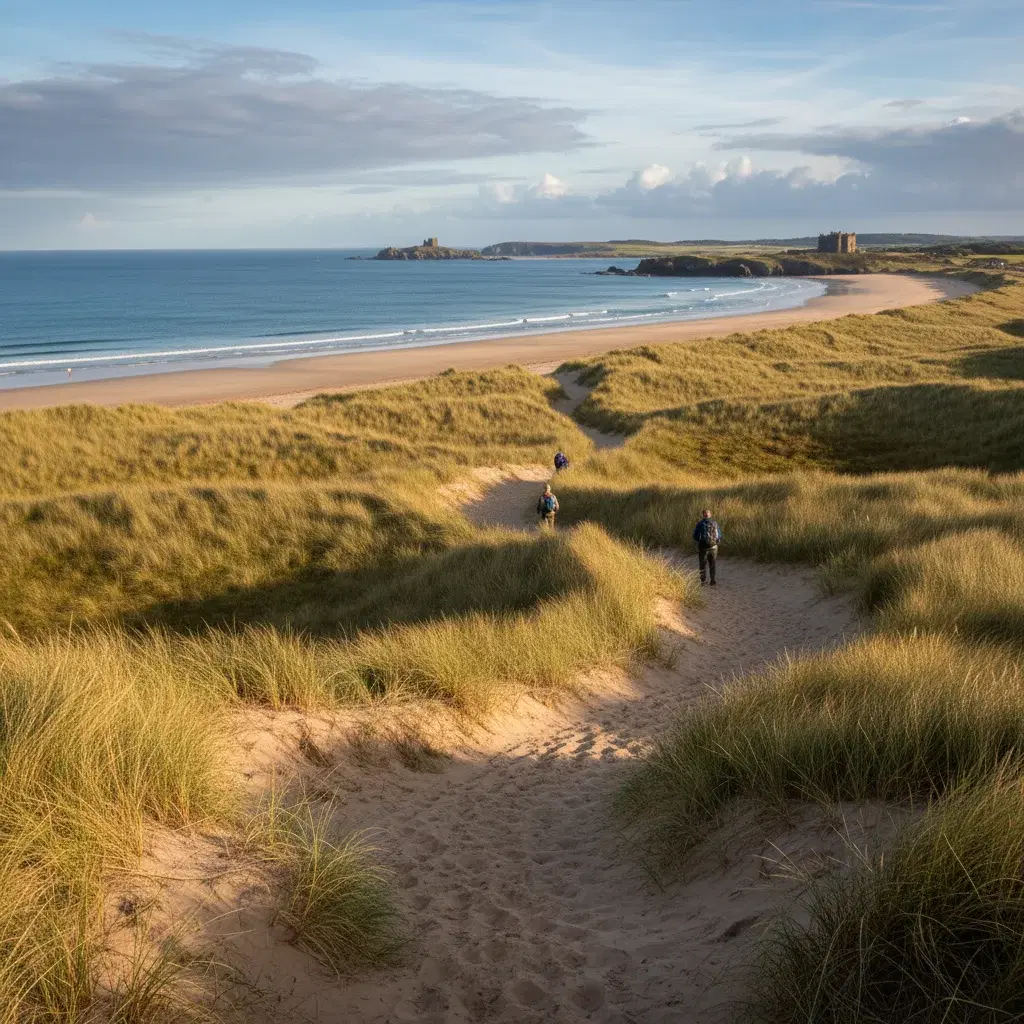
Head east to reach Blyth's South Beach, a long stretch of sand with the famous colourful beach huts. This is one of the most photographed spots in Blyth and a reminder that the town has always been a coastal community as well as an industrial one.
The beach huts are a relatively modern addition, but the beach itself has been a gathering place for generations. During the wars, the coast was heavily fortified, and evidence of wartime defences can still be found in the dunes if you know where to look.
Stop 7: Blyth Battery
Distance to next stop: 0.5 miles | 8 minutes
Continue south along the coast path and across the Links to reach Blyth Battery, one of the most remarkable military heritage sites on the North East coast. The battery was built in 1916 to defend the harbour and its vital coal shipping lanes from German naval threats during the First World War.
Two six-inch naval guns were installed here, and the site includes what is believed to be the only surviving WW1 battery observation post with a rotating turret roof anywhere in the world. The battery was manned again during the Second World War and is now a heritage attraction run entirely by volunteers. Entry is free.
Read our full guide to the Blyth Battery for opening times and what to expect.
Best for: Blyth Battery is free to visit and run by volunteers. The WW1 rotating observation post is believed to be the only one of its kind still in existence.
Stop 8: The Port and Wind Turbines
Distance to next stop: 0.3 miles | 5 minutes
From the Battery, look out to sea. The offshore wind turbines you see are part of the story of Blyth's reinvention. The Blyth Offshore Demonstrator wind farm, operated by EDF, was one of the UK's first offshore wind projects. The port itself has been repurposed as a base for the offshore energy sector, and the Catapult research centre on the quayside develops next-generation turbine technology.
This is the final chapter -- so far -- in a story that runs from medieval salt exports through the coal age, two world wars and a secret submarine base, to clean energy. The harbour that once shipped six million tons of coal a year now serves the industry that is replacing it.
Stop 9: Return to Commissioners Quay (End)
Distance: 0.5 miles | 8 minutes
Walk back along the coast path and quayside to return to your starting point at Commissioners Quay. If you timed it right, you can finish with a drink at the Commissioners Quay Inn overlooking the harbour.
Practical Information
| Detail | Information |
|---|---|
| Distance | Approximately 3.5 miles (5.6 km) |
| Time | 1.5 to 2 hours |
| Terrain | Mostly flat, paved paths and promenades |
| Start/End | Commissioners Quay, Blyth |
| Parking | Free parking at Commissioners Quay |
| Toilets | At Commissioners Quay and South Beach |
| Refreshments | Commissioners Quay Inn, cafes on the High Street |
| Accessibility | Pushchair and wheelchair friendly on most of the route; the Battery section involves grass paths |
Further Reading
- History of Blyth -- the full story from medieval salt port to modern town
- History of Blyth Port -- 900 years of harbour history
- Blyth's Wartime History -- coastal defences, ships, and the secret submarine base
- The Staithes and Coal Heritage of Blyth -- the coal trade that built the town
- Blyth Submarine Base -- the secret war beneath the harbour
- Spirit of the Staithes -- the quayside sculpture
- Blyth Battery Guide -- visiting the coastal defence site
Never miss what’s on
Join the weekly Blyth.live digest — the best events, news and local tips, straight to your inbox. Free, one email a week.