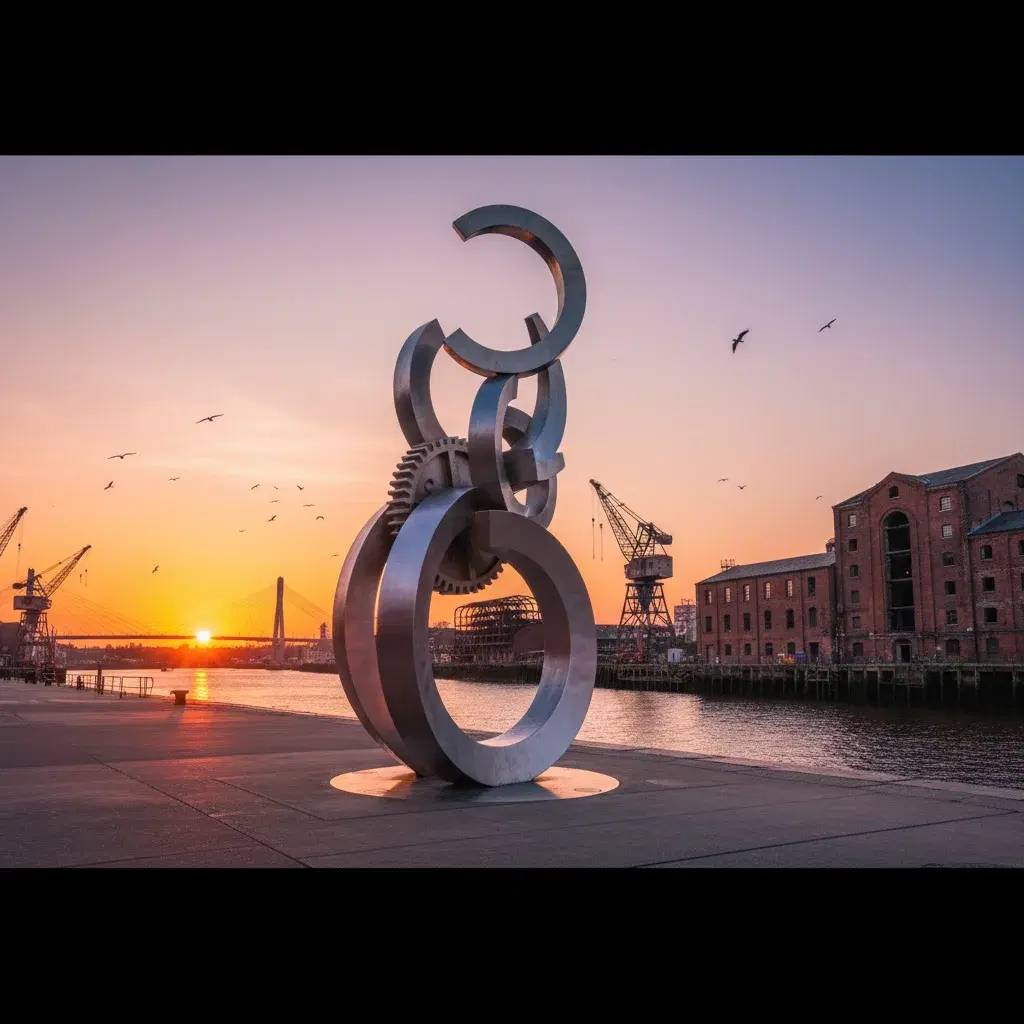
The Spirit of the Staithes: Blyth's Quayside Landmark
A 16-metre polished steel sculpture that reveals a life-size steam train when viewed from the right angle, commemorating Blyth's coal shipping heritage.
Stand on Wellington Street East in Blyth and look towards the quayside. Curved steel beams rise sixteen metres into the sky, supporting a series of flat blocks that seem, at first glance, abstract. But hold your position. From this one precise viewpoint, seven blocks of polished stainless steel lock together to form a single, unmistakable image: a life-size steam locomotive and tender, suspended at the height where the old coal staithes once stood.
This is the Spirit of the Staithes -- one of the most quietly remarkable pieces of public art in the North East.
The Sculpture
Created in 2002 by Sunderland-born artist Simon Packard, the sculpture consists of thirteen curved steel beams supporting seven flat blocks of polished stainless steel. From one specific vantage point on Wellington Street East, the blocks align to reveal the silhouette of a steam train -- the kind that once hauled coal from the collieries down to the harbour.
The sculpture is deliberately set at the height of the original timber ramp -- the staith itself -- down which coal wagons rolled before tipping their loads into the holds of colliers moored below. A ghost of industry, frozen in steel at the exact point where the old world met the sea.
Best for: Thirteen curved steel beams, seven polished stainless steel blocks, sixteen metres tall. From Wellington Street East, the blocks align to form a life-size steam train.
What Were the Staithes?
To understand the sculpture, you need to understand the staithes. A coal staith was a timber structure -- essentially a raised ramp or jetty -- built out over the water at a harbour. Coal arrived from the collieries by rail, and the wagons were pushed along the staith until they reached a position directly above a waiting ship. The bottom of the wagon opened, and the coal dropped straight down into the hold below.
It was brutal, efficient, and enormously profitable. Blyth's staithes were among the busiest on the Northumberland coast, and the town's fortunes were built on this simple mechanism: coal in, ships out.
Blyth's Coal Heritage
Blyth was a thriving coal port for the better part of two centuries. A network of railway lines connected the harbour to the collieries of south-east Northumberland -- Ashington, Bedlington, Cramlington, and beyond. At its peak, millions of tonnes of coal passed through Blyth each year, bound for London, the Continent, and further afield.
The coal trade shaped everything about the town. Generations of Blyth families worked on the staithes, on the railways, or in the harbour. By the 1960s, the collieries had closed, the railway lines were lifted, and the staithes dismantled. Within a generation, almost every physical trace of the industry that defined Blyth had vanished.
Best for: At its peak, millions of tonnes of coal passed through Blyth each year. By the 1960s, the staithes had been dismantled and the coal trade was gone.
The Commission
The Spirit of the Staithes was commissioned by the Blyth Quayside Partnership, a collaboration between Blyth Valley Council, Northumberland County Council, One NorthEast, the Port of Blyth, and Fergusons. The aim was to create a permanent marker of the town's industrial heritage on the quayside where so much of that history played out.
Packard's design was chosen for its cleverness and restraint. Rather than a literal replica of a staith or a locomotive, he created something that rewards attention. Walk past it and you see an abstract arrangement of steel. Stop in the right place and the past appears, assembled from fragments, hovering at the height where real trains once ran.
Old and New Energy
There is a pleasing symmetry to the quayside today. Stand beside the Spirit of the Staithes and look out across the harbour, and you'll see the seventy-six-metre wind turbine that has become another of Blyth's landmarks. Coal and wind, old energy and new, standing within sight of each other on the same stretch of waterfront. Blyth has always been an energy town. The fuel has changed, but the connection to power -- generating it, shipping it, living alongside it -- remains part of the town's character.
Best for: The Spirit of the Staithes and the 76-metre wind turbine stand within sight of each other on the quayside -- old and new energy, side by side.
Visiting
The sculpture is freely accessible on Blyth Quayside. The key viewpoint is Wellington Street East, where the blocks align to reveal the train. It's a popular photography spot, particularly at sunrise and sunset when the polished steel catches the light.
Combine it with a walk along the harbour wall or a visit to one of the town's best cafes for a rewarding half-day out.
Never miss what’s on
Join the weekly Blyth.live digest — the best events, news and local tips, straight to your inbox. Free, one email a week.
What's On
Reclaim, Remake, Reveal
12:30 PM - 2:30 PM · Market Pavilion, Bridge Street, Blyth, NE24 1AP
Your Voice, Blyth's Future: Briardale House Drop-In
10:00am-11:00am · Briardale House, Blyth
The Rock of Ages Experience
7:30 PM · The Phoenix Theatre, 37a Beaconsfield Street, Blyth, Northumberland, NE24 2DS