Blyth's Wartime History
Coastal guns, a secret submarine base, warship production, and a harbour that helped protect Britain's east coast convoys -- how Blyth served in two world wars.
Blyth's contribution to two world wars was far greater than its modest size might suggest. A working coal port with a busy shipyard, it became a place of coastal guns, submarine flotillas, warship construction, and convoy protection. The harbour that had spent centuries shipping coal was turned to the defence of the realm -- and the town paid a price for it.
The First World War
When war broke out in 1914, Blyth was already one of the busiest coal ports in England, and the Admiralty recognised both its strategic value and its industrial capacity immediately.
The Shipyard Goes to War
The Blyth Shipbuilding and Dry Docks Company was pressed into service building vessels for the Royal Navy. The yard produced nine tramps and colliers, ten X-lighter landing craft, and six sloops (patrol vessels used for minesweeping) over the course of the war. But its most remarkable contribution came right at the start. A cargo ship already under construction on the slipway was purchased by the Admiralty in 1914 and converted into HMS Ark Royal -- the Royal Navy's first purpose-built seaplane carrier. Launched in September 1914, she served during the Gallipoli campaign, her aircraft conducting aerial reconnaissance and spotting for naval gunfire. A ship built for Blyth's coal trade became a pioneer of naval aviation.
Best for: HMS Ark Royal, the Navy's first seaplane carrier, was converted from a cargo ship on Blyth's slipway in 1914 and served at Gallipoli.
The Blyth Battery
The German bombardment of Hartlepool in December 1914 sent shockwaves along the North East coast. If the Germans could shell Hartlepool, they could shell Blyth -- and losing the coal port would be a serious blow to the war effort.
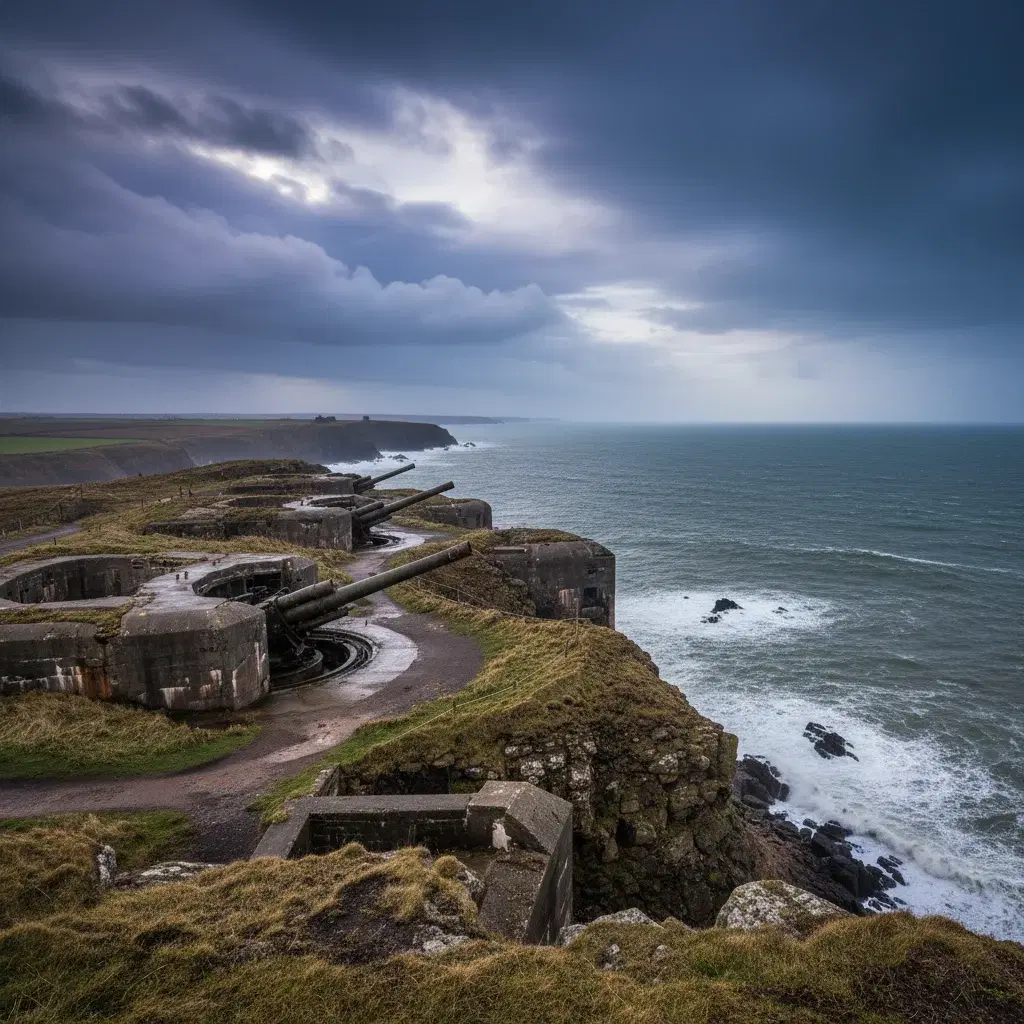
In August 1916, the Durham Fortress Engineers constructed a coastal artillery battery on Blyth Links. Two six-inch quick-firing naval guns were installed, manned by seventy-five men and four officers, with two searchlights scanning the sea at night. The Battery's original role was to prevent enemy landings and engage torpedo boats, but it was also given responsibility for protecting HMS Titania, the depot ship serving the submarines that were beginning to operate from the harbour.
The Blyth Battery is now the most intact coastal defence battery on the North East and Yorkshire coastline, and its WW1 Battery Observation Post -- with its rotating steel turret roof -- is believed to be the only one of its kind surviving anywhere in the world.
Between the Wars
The Wellesley Nautical School, a training establishment for boys, had been operating at Links Road since the original training ship HMS Wellesley was destroyed by fire in 1914. Originally established in 1868 to train young men for service in the Royal and Merchant Navies, it continued to prepare boys for life at sea throughout the interwar years -- many of whom would find themselves in uniform again when war returned.
The Second World War
The Second World War drew even more heavily on Blyth. The harbour, the shipyard, and the coastline all played central roles.
The Submarine Base
In August 1939, with war imminent, the Royal Navy established HMS Elfin at Blyth harbour -- home to the Sixth Submarine Flotilla. The base was shrouded in extraordinary secrecy: access roads blocked, machine gun posts at every approach, canvas screens preventing even Blyth's own residents from seeing the quayside. The small coastal submarines that sailed from Blyth laid mines, gathered intelligence, and attacked enemy shipping off Norway. Their crews called themselves the "Dead Men on Leave." By the end of 1940, the Sixth Flotilla had suffered the worst losses of any British submarine flotilla.
The full story of HMS Elfin is told in our dedicated guide to the Blyth submarine base.
Best for: HMS Elfin, Blyth's secret submarine base, was so heavily guarded that even the town's residents knew almost nothing of what happened behind the wire.
The Battery Reactivated
In February 1940, the Blyth Battery was dug out and reactivated, this time mounted with two six-inch breech-loading guns. Initially called Seaton Battery, it was renamed Blyth Battery in June 1940. The garrison grew to five officers and 110 men of A Battery, 510 Coast Regiment Royal Artillery (Territorial Army). The guns covered the harbour approaches, ready to engage any enemy vessel that threatened the port or the coastal shipping lanes.
By April 1944, with the threat of invasion long past and resources needed elsewhere, the Battery was handed to the Home Guard. It was placed in care and maintenance in late November 1944.
Warship Production
The shipyard continued to build for the Admiralty throughout the war. HMS Blyth, a Bangor-class minesweeper, was ordered in July 1939, laid down in January 1940, and launched in September that year. She went on to serve in minesweeping operations off the east coast and in the English Channel. The yard also built and repaired other vessels for the war effort, maintaining its role as a vital piece of the nation's maritime industrial capacity.
Convoy Protection and Minesweeping
Blyth's harbour served as a base for patrol vessels and minesweepers protecting the east coast convoy routes. The coal that still flowed from Blyth's staithes had to reach southern ports, and the shipping lanes were under constant threat from German mines, submarines, and aircraft. Armed trawlers and minesweepers operated from the harbour, sweeping the approaches and escorting convoys along the Northumberland coast. It was dangerous, unglamorous work -- on Christmas Day 1940, the Hull trawler Loch Doon, minesweeping off Blyth, struck a mine and sank with the loss of fifteen men.
Best for: On Christmas Day 1940, the minesweeper Loch Doon struck a mine off Blyth and sank with the loss of fifteen men.
The Home Front
Blyth did not escape the bombing. In April 1941, German raids caused severe damage to the town, including a direct hit on the railway signal box. The town's population lived with blackout restrictions, rationing, and the constant awareness that the harbour and shipyard made Blyth a legitimate target.
What Remains
The most visible legacy is the Blyth Battery, now preserved and open to visitors from April to September, with free entry and guided tours run by King's Award-winning volunteers. At the harbour, almost nothing visible remains of HMS Elfin -- the sandbags, the screens, and the machine gun posts are long gone. But the quay wall where submarines once moored is still there, and the water they slipped into is the same water that laps against it today.
The shipyard closed in 1967. HMS Blyth's name lives on -- a Sandown-class minehunter commissioned in 2001 carries the name, a quiet nod to the town's wartime contribution to mine clearance.
More on Blyth's heritage: read our guides to the submarine base, the Blyth Battery, Blyth's coal heritage, and the history of Blyth Port. Browse the local directory or check what's on this week.
Know something we've missed? Get in touch and we'll add it.
Never miss what’s on
Join the weekly Blyth.live digest — the best events, news and local tips, straight to your inbox. Free, one email a week.
What's On
Reclaim, Remake, Reveal
12:30 PM - 2:30 PM · Market Pavilion, Bridge Street, Blyth, NE24 1AP
Your Voice, Blyth's Future: Briardale House Drop-In
10:00am-11:00am · Briardale House, Blyth
The Rock of Ages Experience
7:30 PM · The Phoenix Theatre, 37a Beaconsfield Street, Blyth, Northumberland, NE24 2DS