Blyth's Shipbuilding Heritage
From wooden sailing ships in 1811 to corvettes, frigates, and the Royal Navy's first seaplane carrier -- the story of Blyth's shipyards and the workers who built them.
For over 150 years, Blyth was a shipbuilding town. The yards on the south bank of the River Blyth launched wooden sailing ships, coal colliers, tramp steamers, torpedo boats, minesweepers, corvettes, frigates -- and one vessel that changed the history of naval aviation. This is the story of Blyth's shipbuilding heritage, from the first wooden hulls to the yard's closure in 1967.
Early Beginnings: 1811--1860s
Shipbuilding on the south bank of the River Blyth dates to 1811, when the first yard was established to build and repair small vessels for the coastal coal trade. In the 1840s, the yard was purchased by Beaumont and Drummond. By 1863, under new owners Hodgson and Soulsby, the yard was repairing and building small wooden sailing ships -- the kind that worked the coasting trade between Blyth, London, and the ports of northern Europe.
These were modest operations. Blyth was still primarily a coal port, and its shipbuilding served the needs of the coal trade rather than any grand naval ambition. But the river was deep enough, the labour was available, and the iron and steel industries of the North East were expanding. The conditions for growth were all in place.
The Blyth Shipbuilding and Dry Docks Company
On 2 March 1883, the Blyth Shipbuilding and Dry Docks Company Limited was registered as a limited liability company. This was the yard's transformation from a small repair operation into a serious commercial enterprise.
The company built cargo liners, tramp steamers, and colliers -- the unglamorous workhorses of the merchant fleet. The colliers were particularly important: Blyth was one of the busiest coal ports in England, and the ships that carried Northumberland coal to southern ports were built, repaired, and maintained within sight of the staithes where the coal was loaded.
Best for: The Blyth Shipbuilding and Dry Docks Company was registered in 1883 and built cargo liners, tramp steamers, and colliers for the merchant fleet.
The dry dock itself was a major asset. Ships that traded along the North East coast could be hauled out of the water at Blyth for hull repairs, repainting, and overhaul without making the longer journey south to the Tyne or the Wear. The yard became a self-contained maritime workshop -- building new vessels and keeping old ones seaworthy.
The First World War: Warships and a Pioneer
When war broke out in August 1914, the Admiralty recognised both the strategic value of Blyth's harbour and the industrial capacity of its shipyard. The yard was pressed into service building vessels for the Royal Navy.
HMS Ark Royal
The yard's most remarkable contribution came right at the start. A cargo ship already under construction on the slipway -- probably intended for the Black Sea coal-for-grain trade -- was purchased by the Admiralty in May 1914. She was converted on the slipway into a seaplane carrier, fitted with a forward hold large enough to store and maintain seaplanes, a crane for hoisting them over the side, and workshops for the aircrew.
Launched on 5 September 1914 as HMS Ark Royal, she was the first ship in history designed and built (or in this case, converted during build) as a seaplane carrier. She served during the Gallipoli campaign in 1915, her aircraft conducting aerial reconnaissance and spotting for naval gunfire over the Dardanelles. A ship intended for Blyth's coal trade became a pioneer of naval aviation.
Best for: HMS Ark Royal, the world's first seaplane carrier, was converted from a cargo ship on Blyth's slipway in 1914 and served at Gallipoli.
Other WWI Production
Beyond the Ark Royal, the yard built torpedo boats, destroyers, minesweepers, and X-lighter landing craft for the British Admiralty. The wartime output included nine tramps and colliers, ten X-lighter landing craft, and six sloops used for minesweeping and patrol duties. The yard ran at full capacity throughout the war, its workforce swelling as the Admiralty's demands grew.
Between the Wars
The interwar years were difficult for British shipbuilding. The post-war slump hit hard, and yards across the North East struggled with cancelled orders and shrinking demand. Blyth's yard survived, continuing to build merchant vessels, but the boom years of wartime production were over.
The workforce contracted. Skilled men who had built warships found themselves unemployed or working reduced hours. It was a pattern repeated in every shipbuilding town from the Tyne to the Clyde -- and one that would become grimly familiar again after 1945.
The Second World War: Corvettes, Frigates, and Minesweepers
The outbreak of war in 1939 brought the yard back to full production. The Admiralty needed escort vessels, minesweepers, and patrol craft in enormous numbers, and Blyth's yard was one of dozens pressed into service along the North East coast.
HMS Blyth
One of the first wartime orders was HMS Blyth, a Bangor-class minesweeper ordered in July 1939, laid down in January 1940, and launched in September that year. She served in minesweeping operations off the east coast and in the English Channel, clearing the approaches for convoys and invasion fleets alike. The town could look out at the harbour and know that a ship bearing its name was somewhere at sea, sweeping for mines.
The Full Wartime Output
Over the course of the war, the Blyth Shipbuilding Company built an extraordinary range of vessels for the Royal Navy:
- Ten Bangor-class minesweepers -- including HMS Blyth
- Two Flower-class corvettes -- the small, tough escort vessels that bore the brunt of the Battle of the Atlantic
- Seven Castle-class corvettes -- improved versions of the Flower class, with better sea-keeping and armament
- Five River-class frigates -- larger escort vessels for convoy protection
- Two Bay-class frigates -- the final evolution of the wartime escort design
These were not prestige warships. They were the workhorses of the convoy war -- small, unglamorous, and often desperately uncomfortable in heavy seas. But without them, the Atlantic supply lines would have been severed. Blyth's yard played its part in keeping them open.
Best for: During the Second World War, Blyth's shipyard built ten minesweepers, nine corvettes, and seven frigates for the Royal Navy.
The Workforce
At its peak, the Blyth Shipbuilding Company employed hundreds of men. Riveters, platers, caulkers, welders, fitters, joiners, painters, and labourers worked in all weathers on the open slipways and in the fitting-out basin. The work was skilled, physical, and dangerous. Falls, burns, and crushing injuries were common. The noise of riveting was deafening.
Many of the workers came from the pit villages around Blyth -- Newsham, New Delaval, Cowpen -- where the mining and shipbuilding communities overlapped. A man might have a father down the pit and a brother in the yard. The two industries were the twin pillars of Blyth's economy, and both demanded the same qualities: physical toughness, technical skill, and a willingness to work in conditions that would appal a modern health and safety inspector.
Women entered the yard in significant numbers during both world wars, working as welders, crane operators, and in the fitting shops. Their contribution was essential -- and, as in most industries, largely unacknowledged once the men came home.
Decline and Closure
After the Second World War, the British shipbuilding industry entered a long decline. Foreign competition -- particularly from Japan and later South Korea -- undercut British yards on price and delivery times. Government subsidies propped up the industry for a while, but the economics were brutal.
Blyth's yard struggled. Orders dried up. The workforce shrank. After losing money for five years, the yard was finally closed in 1967. The slipways that had launched warships fell silent. The cranes were dismantled. The dry dock that had served the North East's merchant fleet for over eighty years was abandoned.
It was a familiar story across the region. Sunderland, Wallsend, Hebburn, Jarrow -- one by one, the yards that had built the ships of the British Empire and two world wars closed their gates for the last time.
What Remains
Almost nothing visible remains of the Blyth Shipbuilding Company today. The yard site on the south bank of the river has been cleared and redeveloped. The dry dock is gone. The slipways are gone.
But the legacy is real. Ships built at Blyth served in two world wars. HMS Ark Royal pioneered a form of warfare -- carrier aviation -- that would dominate the twentieth century. The name HMS Blyth lives on: a Sandown-class minehunter commissioned in 2001 carries the name, a quiet nod to the town's wartime contribution to mine clearance.
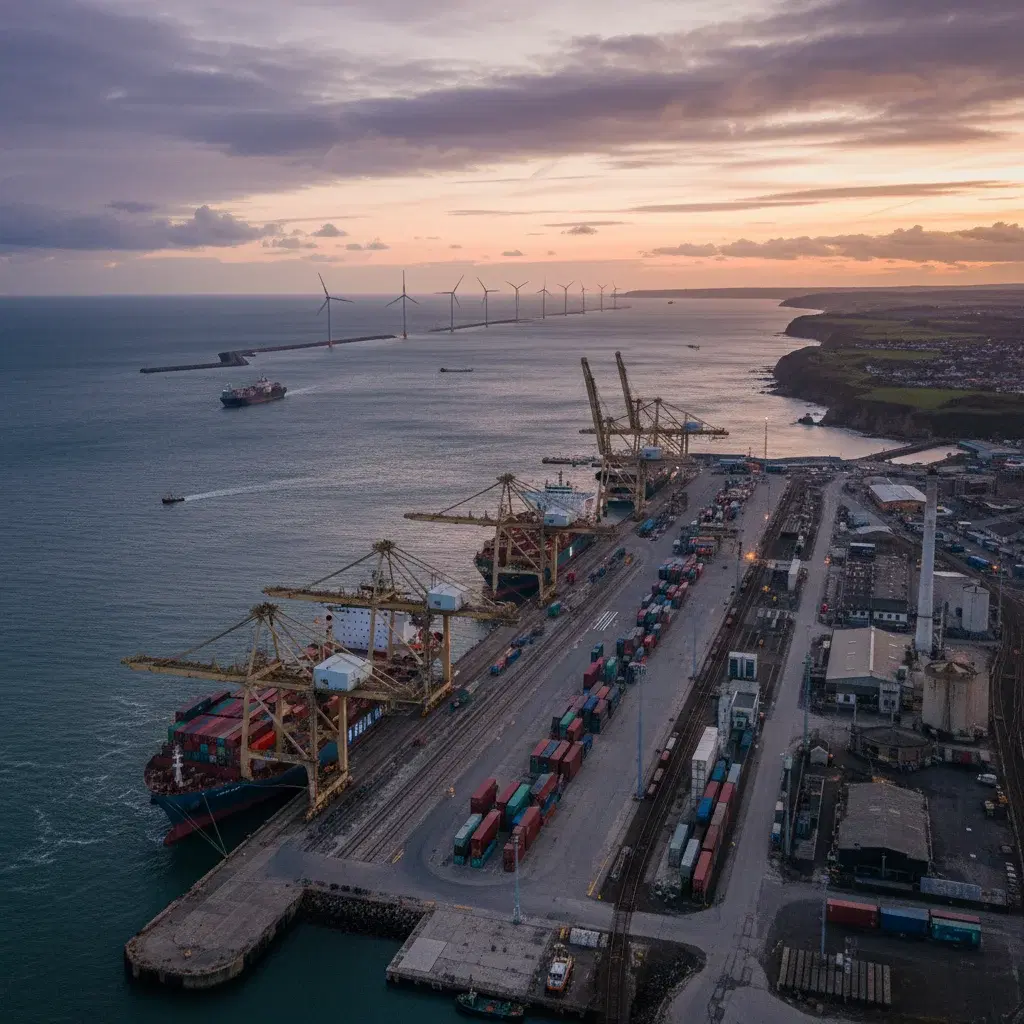
The Port of Blyth continues to operate, now focused on offshore wind energy rather than coal. The harbour that launched wooden sailing ships in 1811 is helping to build the wind farms of the twenty-first century. The industry has changed. The river has not.
More on Blyth's heritage: read our guides to Blyth's wartime history, the submarine base, the Blyth Battery, Blyth's coal heritage, and the history of Blyth Port. Browse the local directory or check what's on this week.
Know something we've missed? Get in touch and we'll add it.
Never miss what’s on
Join the weekly Blyth.live digest — the best events, news and local tips, straight to your inbox. Free, one email a week.