Blyth's Finest Historic Buildings: The Old Police Station and Harbour Commissioners' Offices
A guide to three of Blyth's most striking listed buildings, from the derelict but magnificent old police station to the Harbour Commissioners' Offices with their ship's-wheel staircase.
Blyth is a working town, and it wears its history in brick and stone rather than behind velvet ropes. Walk along Bridge Street and you pass two buildings that most people hurry by without a second look, yet both are nationally listed and both tell you almost everything about what Blyth once was: a busy port with courts to keep, coal to ship and a harbour to run. This guide gathers three of the town's finest historic buildings, what makes each one special, and what has become of them. It is a companion to our wider History of Blyth and the self-guided heritage walking trail, which take in more of the town's landmarks on foot.
The Old Blyth Police Station, Bridge Street
Of everything on this list, the old police station is the building people most often stop to ask about, and with good reason. Built in 1896 to the design of the county architect John Cresswell, it stands on Bridge Street (NE24 3AA) in red brick with a wealth of carved detail, marble columns and a busy roofline of gables, turrets, chimney stacks and a small belfry. It is an exuberant piece of late-Victorian civic architecture, Italianate and Gothic at once, and it was built to do a serious job: as well as the police station it housed a magistrates' court and a sergeant's flat.
Its reputation is not just local pride. When Nikolaus Pevsner surveyed Northumberland for his Buildings of England series, he judged this the best building in Blyth, and it is protected accordingly. The old police station is Grade II listed (Historic England list entry 1371413), which recognises it as a building of special architectural and historic interest.
The sadder part of the story is its present state. The station closed in 2015, with policing moving to newer premises elsewhere in the town, and the building has stood empty and deteriorating ever since. A plan to convert it into offices came before the council in early 2023 but was refused, so its future remains uncertain. For now it is best appreciated from the pavement, where the carved stonework and that extraordinary roofscape are still very much worth pausing over.
Best for: Admiring Blyth's grandest Victorian architecture. View it from the street; the building is derelict and not open.
The Former Harbour Commissioners' Offices, Bridge Street
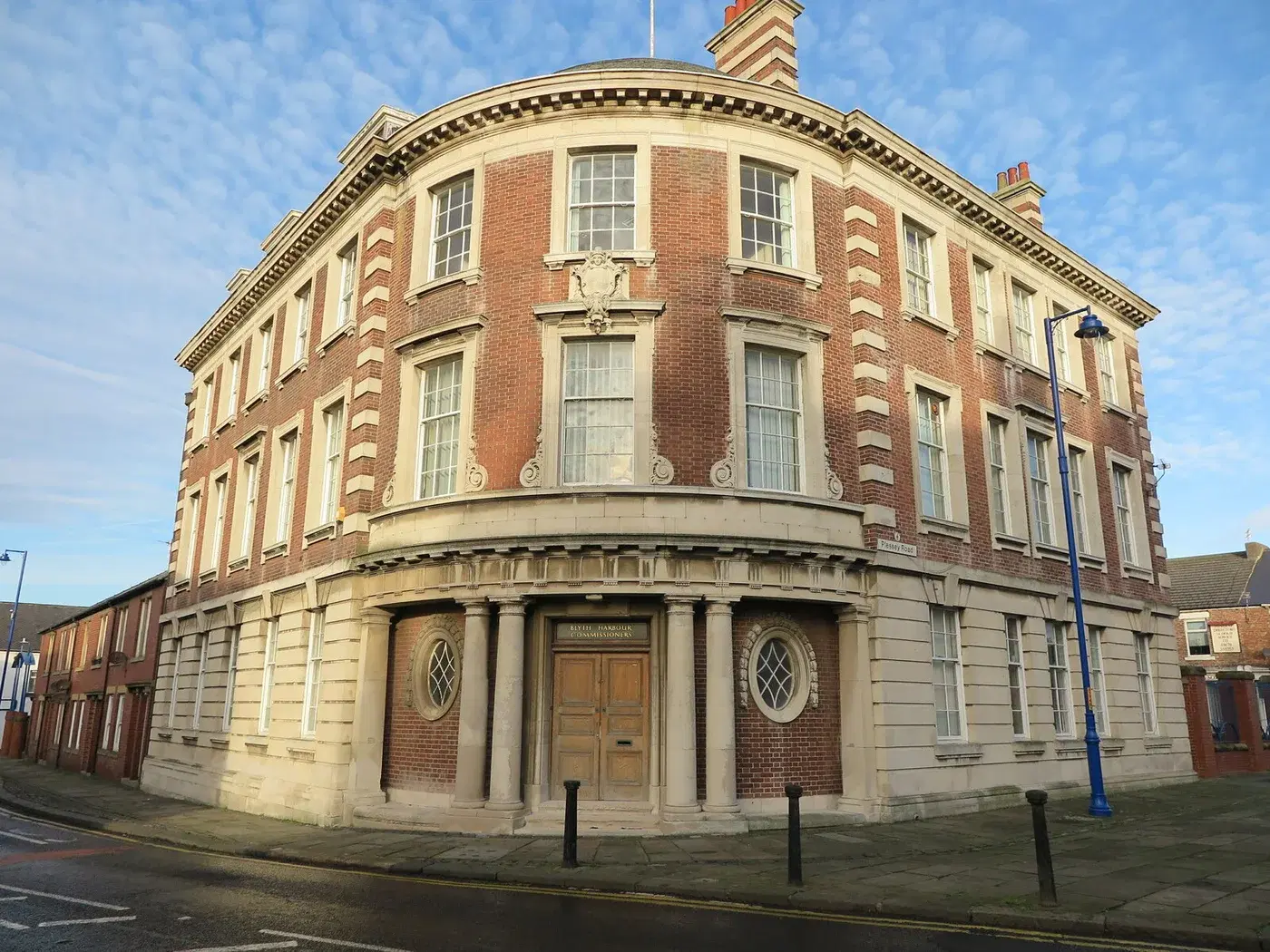
A short walk away, on the corner where Bridge Street meets Plessey Road, stands the building that ran Blyth's harbour in its heyday. The Harbour Commissioners' Offices were completed in 1913 to the design of the Newcastle firm Cackett & Burns Dick, the same practice behind the famous concrete dome of Whitley Bay's Spanish City. The architects handed the building over to the Commissioners in July 1913, and it is Grade II listed (list entry 1041341).
You can read the building's purpose in its shape. It sits on a curving corner site, faced in brick with pale stone dressings, and its columned entrance carries the words "Blyth Harbour Commissioners" above the door. This was the nerve centre of the port when Blyth was one of the busiest coal-shipping harbours in the country, and no expense was spared inside.
The interior is where the real character lies, although it is not the sort of thing you see from the street. A grand staircase rises from the entrance lobby, and its wrought-iron balustrade is worked with ship's-wheel motifs, a quiet nod to the maritime business conducted here. The stairs lead up to a panelled boardroom decorated with panels of Dutch glazed tiles, most showing landscapes, which were salvaged from the SS Walmer Castle, a liner built by Harland & Wolff in 1902 and broken up at Blyth in 1932. Reusing the tiles from a scrapped ship in the very building that oversaw the town's shipping is a lovely piece of history, and typical of a port that never wasted anything of value.
The offices are still in use today, so the historic interior is not generally open to the public. That makes the exterior all the more worth appreciating, and it is one of the more photogenic corners of the town.
Best for: A glimpse of Blyth's maritime prime. The building is in private office use; the interior is not open to visitors.
The High Light, Bath Terrace
For something older and stranger, head towards Bath Terrace and look up for the High Light. This slim stone lighthouse dates from 1788, which makes it one of the oldest structures in the town, and it too is Grade II listed (list entry 1371411). It was commissioned by Sir Matthew White Ridley, whose family did so much to develop the port, and it stands, unusually, tucked in among houses rather than out on the shore.
The reason is that Blyth's harbour entrance shifted over the years, and the light was raised more than once to keep it useful, ending at close to nineteen metres tall. It worked in partnership with a Low Light to guide ships safely in until it was retired in 1985, when modern navigation aids took over. It is an evocative survivor, and a reminder that Blyth's story has always been written by the sea. The Ridley name also lives on at Ridley Park, the town's handsome Edwardian park a little to the south.
Best for: A quiet piece of Georgian Blyth. A protected landmark in a residential street, best enjoyed from the surrounding pavements.
A note on prehistoric Blyth
Blyth's history runs a great deal deeper than its Victorian and Georgian buildings. In November 2022 a walker on Blyth beach at low tide spotted a large skull protruding from the sand, and after she photographed it and got in touch, staff at the Great North Museum: Hancock in Newcastle identified it as an aurochs, the huge wild cattle that roamed Britain thousands of years ago before dying out. Reported in the Northumberland Gazette, the find is a striking reminder that the coast here has been washing up its past for a very long time.
Best for: You may hear a piece of local lore about an aurochs skull once displayed at the top of the Harbour Commissioners' staircase. We have not been able to confirm that story, and mention it only as unverified. The properly documented find is the one from Blyth beach described above.
Seeing them for yourself
All three buildings sit within an easy walk of one another around Bridge Street and the older heart of the town, so a single afternoon takes them all in. If you enjoy this kind of thing, the town's shipbuilding heritage and its staithes and coal heritage fill in the industrial story that these grand civic buildings were built to serve, and the heritage walking trail links many of them into one route.
Know more about any of these buildings, or spotted a detail we have missed? Get in touch and we will happily update the guide.
Local businesses mentioned
Never miss what’s on
Join the weekly Blyth.live digest — the best events, news and local tips, straight to your inbox. Free, one email a week.
What's On
Doing Shakespeare
7:30 PM · The Phoenix Theatre, 37a Beaconsfield Street, Blyth, NE24 2DS
Play, Discover and Grow
10:15 AM - 11:00 AM and 11:15 AM - 12:00 PM · Market Pavilion, Bridge Street, Blyth, NE24 1AP
Blyth u3a Monthly Meeting
1:00 PM - 3:00 PM · Blyth Town Football Club Hall, South Newsham, Blyth