Photography Spots in Blyth
From the colourful beach huts on South Beach to the offshore wind farm at sunset, here are the best spots for photography in and around Blyth.
Blyth's working harbour, long sandy beach, and industrial-maritime heritage give it a photographic character quite different from the prettier resort towns along the coast. The subjects here are bold and graphic -- colourful beach huts, offshore wind turbines, piers, and wide-open skies over the North Sea.
South Beach and the Beach Huts
The row of 20 brightly painted timber beach huts on South Beach is probably the most photographed subject in Blyth. Built as part of the town's seafront regeneration, the huts were individually named by local schoolchildren, whose artwork is displayed inside. Shoot them front-on for bold blocks of colour, or from the side for a receding perspective line. Overcast days bring out saturated colour; low afternoon sun rakes warm light across the timber.
Best for: Parking is directly behind the huts. Early morning gives you the cleanest light and no crowds. The huts face roughly east, so they catch the sunrise glow.
Blyth South Pier
The old wooden south pier at the harbour entrance is a characterful subject -- weathered timber, rusting ironwork, and peeling paint. The pier provides a strong leading line out to sea, with the North Pier lighthouse visible in the distance. Stormy days bring dramatic wave action against the structure. For calmer conditions, the reflections of the pier posts in the harbour water at low tide make for satisfying abstract compositions.
The Offshore Wind Farm
Blyth's offshore wind farm is visible from the beach and promenade. The turbines make striking subjects, particularly at sunrise or sunset when they are silhouetted against the sky. A telephoto lens (200mm or longer) compresses the perspective and stacks the turbines together. In misty conditions the turbines emerge from the haze, creating an almost otherworldly scene.
Ridley Park
Blyth's main public park, opened in 1904, has mature trees, a bandstand, bowling greens, and a boating lake. The lake provides reflections in still conditions, and the mature trees are at their best in mid-October when autumn colour peaks. The bandstand is a useful compositional element. Early morning mist in autumn settles over the lake and creates atmospheric conditions.
The Port and Harbour
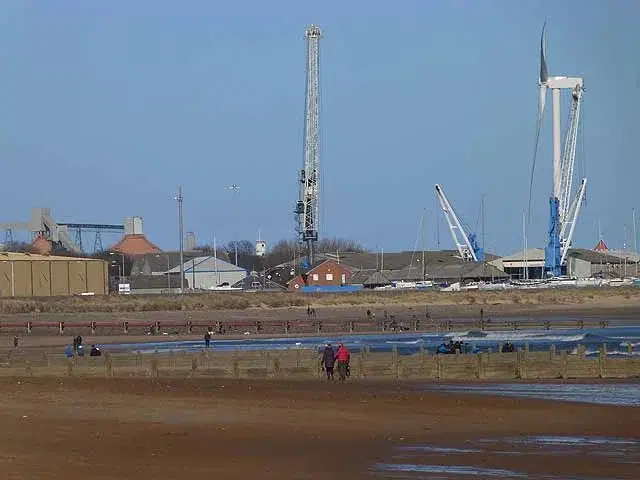
Blyth is a working port, and the industrial infrastructure -- cranes, cargo ships, and quayside buildings -- provides raw material for documentary and urban photography. The quayside at Commissioners Quay offers good vantage points looking across the harbour. The mix of old and new industry along the waterfront tells the story of a town in transition.
Best for: Be mindful of restricted areas around the working port. Public access along the quayside and the Commissioners Quay area is fine for photography.
Seaton Sluice
A few minutes south of Blyth, the small inlet at Seaton Sluice is worth a detour. The narrow channel was cut in the 17th century to allow coal ships to enter and leave. The harbour walls, the rocky shoreline, and the view north towards Blyth provide strong compositions. Low tide reveals rock pools and textured geology. The Delaval Arms overlooks the harbour if you need refreshments between shots.
The Links and North Beach
North of the harbour, the Links stretch along the coast towards Cambois. The dune grass, wide sands, and long views up the Northumberland coast offer a wilder, quieter alternative to South Beach. Sunset light here can be remarkable, with the sky reflected in wet sand at low tide. Wading birds on the shoreline provide wildlife subjects, particularly in autumn and winter.
Have a favourite photography spot in Blyth we've missed? Get in touch via our contact page.
Never miss what’s on
Join the weekly Blyth.live digest — the best events, news and local tips, straight to your inbox. Free, one email a week.
What's On
Reclaim, Remake, Reveal
12:30 PM - 2:30 PM · Market Pavilion, Bridge Street, Blyth, NE24 1AP
Your Voice, Blyth's Future: Briardale House Drop-In
10:00am-11:00am · Briardale House, Blyth
The Rock of Ages Experience
7:30 PM · The Phoenix Theatre, 37a Beaconsfield Street, Blyth, Northumberland, NE24 2DS